Let’s Start with Auxiliary Materials.
When it comes to home renovation materials, I’ve written about them many times, but never systematically. Today, let’s dive in and explore the essentials.
Renovation materials can be broadly divided into two types: those used in the basic construction phase to ensure fundamental needs like water and electricity, such as pipes, wires, waterproof coatings, cement, sand, ceiling joists, etc. These materials are hidden behind decorative layers after homeowners move in, so we call them auxiliary materials.
The other type is used on the surface after basic construction, ensuring comfort and aesthetics, materials that homeowners can directly feel, use, and experience, such as flooring, tiles, paint, toilets, showers, range hoods, and more.
Although both are renovation materials, general homeowners’ awareness and market prices for them are vastly different, so they need to be discussed separately.
Auxiliary materials often seem mysterious to ordinary homeowners. As the question goes, we know to choose good ones, but what defines “good”? On various renovation platforms, including Zhihu, auxiliary materials are rarely emphasized—not because they’re unimportant, but because homeowners are less likely to encounter issues with them (especially compared to main materials). I analyze three reasons for this.
1. The auxiliary materials market is simple and healthy.
Have you noticed that common auxiliary material brands are often large, near-monopoly enterprises? For example, Saint-Gobain for gypsum boards, Oriental Yuhong for waterproofing, and Golden Bull for pipes.
Even without these brands, other common ones typically have regional monopoly status, like Chuanlu for conduit pipes or Tapai for wires in Sichuan.
I estimate that for any given type of auxiliary material, homeowners generally encounter no more than five well-known brands. This limited choice is actually beneficial, as these brands offer reliable quality—whether for wires or pipes, picking a familiar brand can last over a decade without issues. This simple, healthy market contrasts sharply with main materials.
I often compare auxiliary materials to daily necessities like soap,纸巾, or instant noodles—produced by major companies but with low unit prices and small price differences between brands.
For instance, in electrical wiring renovations, cheaper options like Tapai cost around 122 yuan per roll (100 meters), while better ones like Golden Mink flame-retardant wires sell for only 152 yuan per roll—a mere 30 yuan difference. For a full-house renovation, the total cost difference might only be a few hundred yuan.
Compared to main materials, if auxiliary materials are daily necessities, then main materials are like women’s skincare products. We might spend a minute choosing soap based on scent and brand, but skincare requires extensive testing and research, largely due to the stark price differences and the time invested in selection.
3. Construction often combines with auxiliary materials.
As you might know, renovation generally comes in three models: labor-only (qingbao), labor plus auxiliary materials (banbao), and full package (labor, auxiliary, and main materials).
In my experience, I’ve rarely met homeowners who handle qingbao themselves. One reason is that auxiliary materials have low unit prices and profit margins—running around markets for months saves little money. Another is that labor-only projects offer low profits, so contractors avoid them unless management fees are paid separately.
Thus, the market is dominated by banbao and full package options, which bundle auxiliary materials, leaving homeowners little choice (many companies don’t even offer options). Combined with the previous factors, auxiliary materials receive less attention, and there’s no need to spend excessive time on them.
Finally, for convenience, I’ve compiled a list of auxiliary material brands based on my experience. While I can’t vouch for nationwide, in Chengdu at least, using these brands and ensuring they’re genuine minimizes the risk of failure. Now, let’s focus on the main points of interest.
Main materials account for the largest portion of the renovation budget, with numerous brands, models, and greater homeowner autonomy, making the market hundreds of times more complex than auxiliary materials. Based on purchasing characteristics, I’ve divided main materials into four parts.
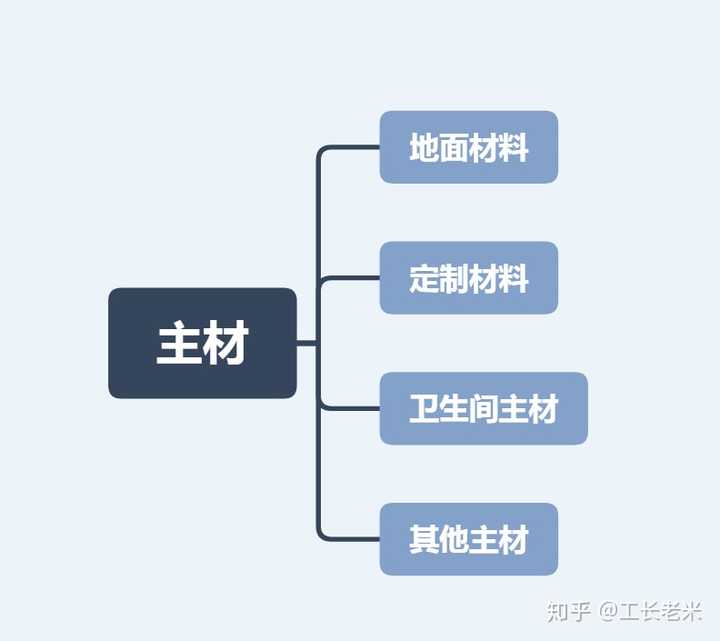
Currently, main materials for floors are typically tiles or flooring, with occasional use of terrazzo or self-leveling techniques, but these are less common. We’ll focus on how to choose tiles and flooring.
For tile selection, I’ll discuss two aspects: quality and price.
The first question many face is: Should I buy Guangdong tiles?
In the tile market, especially among sellers, Guangdong tiles are often synonymous with quality, leading some homeowners to insist on them. In reality, it’s unnecessary—it’s more of a marketing gimmick, and you’re unlikely to get genuine ones.
Take Chengdu’s tile market as an example: 90% of so-called “Guangdong tiles” are actually from Jiajiang, just sold under the Guangdong name. If the market were flooded with real Guangdong tiles, Guangdong would probably be excavated empty!
In terms of quality, Guangdong tiles do have a slight edge due to soil quality, but the cost isn’t worth it. The biggest expense for shipping real Guangdong tiles to Sichuan isn’t the tiles themselves but transportation. In Chengdu, you can’t buy genuine Guangdong tiles for under 200 yuan/㎡; with that budget, you can already get big-brand tiles.
Setting aside origin, how should we choose tiles? I’ve summarized some tips from my experience.
Good tiles have a gray or off-white body color.
Check the body for impurities—poor soil quality results in tiles with black spots, for instance, from excess iron. Many cheap tiles at 20-30 yuan/㎡ have impure bodies with impurities, making them brittle and best avoided.
The glaze on tiles should ideally be thicker; if too thin, the tile wears easily.
Brand markup for tiles is extremely severe, even among main materials where markup is common.
You can gauge markup by looking at sales commissions. I recall four or five years ago, a well-known tile brand offered 50% commissions to salespeople (though competition has reduced this now). That’s just sales commissions, excluding ads, venue costs, shipping, etc.—imagine how scary the markup is.
Since tile manufacturing isn’t overly complex, and they’re hard to damage if installed without hollow spots, the quality gap between large and small factories isn’t huge. If your renovation budget isn’t generous, there’s no need to pursue brands. For example, 800×800 living room tiles at 120–150 yuan/㎡ are perfectly usable, and 300×300 bathroom and kitchen tiles at 70–80 yuan/㎡ are decent.
Of course, expensive tiles have their reasons—the differences lie in patterns and texture for aesthetics, not practicality.
Flooring markup is less severe than tiles, and the market is relatively mature. While not entirely “you get what you pay for,” flooring prices are heavily influenced by materials.
For instance, solid wood flooring is famously expensive—regardless of usability, the high cost is principled because solid wood materials are inherently more expensive than composite or multi-layer boards.
Similarly, multi-layer composite boards are generally priced higher than laminate flooring (though some branded laminates are also pricey), again due to higher costs.
Lastly, on environmental concerns: flooring has higher formaldehyde levels than tiles, but don’t worry too much. Modern manufacturing processes are mature, and as long as you buy正规 flooring, environmental standards are usually met.
Custom-type main materials mainly refer to three categories: custom cabinets, custom kitchen cabinets, and custom doors and windows. Let’s discuss them in detail.
Custom cabinets are probably the biggest expense among main materials. For two bedrooms, customizing two wardrobes plus a shoe cabinet and laundry cabinet can easily cost 10,000–20,000 yuan.
Price differences for custom cabinets are large, primarily based on business scale. Branded custom options, like索菲亚 or欧派, average around 1300 yuan/㎡, while non-branded small businesses are cheaper, averaging 600–800 yuan/㎡. Most budget-conscious families opt for small businesses.
The price gap between branded and non-branded is significant, but I don’t feel the quality difference is that big. Although called custom, cabinet manufacturing isn’t complex—businesses use finished boards (e.g., Kronospan, Egger,兔宝宝,露水河), with differences mainly in design and installation details like edging.
The large price difference doesn’t mean expensive options are scams or cheap ones are poor—it depends on your消费观. If money isn’t an issue and you seek质感, choose big brands with better service and details. For刚需 families, go for small businesses with better性价比.
Wardrobe and kitchen cabinet markets are similar, with many businesses handling both.
Kitchen cabinet customization also splits into big brands and small businesses, with about half the price difference. But kitchen cabinets differ from wardrobes in one key aspect, which is why I’m discussing them separately.
The most unique thing about kitchen cabinets is their pricing method, which can be tricky for renovation newbies to navigate.
Wardrobes are usually priced by投影面积, but kitchen cabinets aren’t—they’re itemized: countertops at one price, cabinets at another, pull-out baskets and racks sold separately, holes drilled for extra fees, etc. It’s very complicated. Often, homeowners mistake a single item’s price for the total, get忽悠ed by sales, and find the final cost far exceeds expectations after paying a deposit.
I’ve thought about this: businesses make pricing complex mainly because quoting a total price upfront seems too expensive and scares customers away.
Of course, kitchen cabinet sellers offer套餐报价, like a package with so many meters of cabinets, base cabinets, countertops, and maybe a free range hood. It looks great, but in reality, these packages have limited options and often exclude pull-outs, dish racks, drawers, etc., potentially costing more than itemized pricing in the end.
Doors, especially wooden ones, have a complex market, though not as bad as tiles, with serious brand markup. For刚需, a 1000+ yuan painted door is more than sufficient for daily use. If you want better, spend more on good locks and hardware, or upgrade the soundproofing strips.
For刚需 families, I don’t think doors costing 4000–5000 yuan or even 10,000 are necessary.
Brands boast about materials,环保, high-tech, etc., but think about it: a door’s main function is separation. Our key needs are that it doesn’t warp, opens and closes smoothly, and has good sound insulation. As for环保, how much area does a door cover? How much formaldehyde can it emit? And high-tech—even if real, it’s still just a door.
Nowadays, homeowners also care about颜值, but the entire door industry copies designs. Non-branded doors can look great too, so if budget is tight, no need to overspend on doors.
Window customization is more complicated and hard to summarize briefly. I’ve written a dedicated piece on it; interested friends can check it out here.
Bathroom main materials are essentially bathroom fixtures, including toilets, vanity cabinets, showers, and五金 like drains.
Compared to other main materials, the bathroom fixture market is mature and straightforward.
Brands aren’t without markup, but it’s mostly you get what you pay for. If you’re interested, visit markets and compare—unlike branded tiles or cabinets, branded bathroom fixtures rarely have big discounts. If you see a major brand with huge markdowns, it’s likely counterfeit.
So, if you want to save on bathroom fixtures, buy non-branded—they’re much cheaper. But personally, I think bathroom fixtures are worth investing in more than tiles or flooring, because they’re used frequently. Long-term, better ones last longer and offer a better experience.
Also, for bathroom五金 like drains, angle valves, and faucets, I recommend buying the best within your budget. Though price differences are large, unit costs are low—upgrading all to brands might only cost a few hundred to a thousand yuan more, offering great性价比.
Other main materials主要指墙面装饰 like paint,硅藻泥, and wallpaper. Different companies classify these as main or auxiliary; I categorize them as main. Let’s take a closer look.
Paint is worth discussing—in earlier years, brand markup was severe. Sellers just marketed against formaldehyde, labeling products as odor-free, non-toxic, formaldehyde-absorbing, etc., and they sold easily. But now, homeowners are more rational, less fearful of paint’s甲醛 issues, so the market is normalizing. For price and buying tips, I won’t elaborate here; interested readers can follow the link below.
硅藻泥 as a wall decoration was niche three years ago, but not anymore. On Zhihu, I often get questions like: Is硅藻泥 a智商税?
My view on whether it’s a智商税 depends on your purpose for buying it.
Wallpaper has lower性价比 than paint and doesn’t suit the popular “minimalist” style well, but for cozy or质感-focused styles, it’s suitable, though good wallpaper isn’t cheap.
Above are some of my suggestions for renovation material choices—I hope they’re helpful.

 WhatsApp contact me online